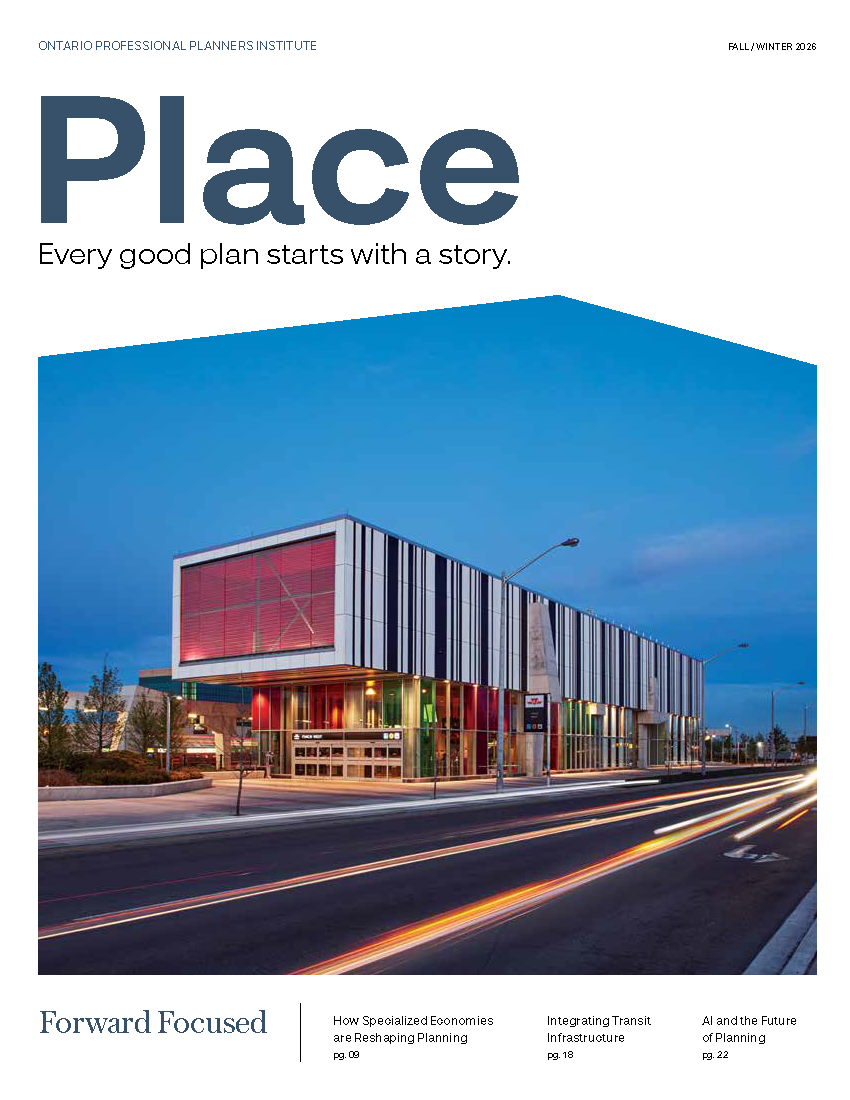
Place Magazine
Every good plan starts with a story.
Big ideas. Real stories. Better places.
Welcome to Place Magazine, OPPI’s bold new publication (formerly Y Magazine), designed to bring planning to life through the stories, people, and ideas shaping our communities.
Place Magazine represents where planning happens, where ideas come together, and where the future of our communities takes shape. It continues OPPI’s commitment to showcasing the role and value of Registered Professional Planners (RPPs) while broadening the lens to explore the interconnected social, economic, environmental, and infrastructure issues that influence how we live.
It’s how we live, move, connect, and grow.
What is Place?
Place is where insight meets impact.
We go beyond theory to spotlight:
- The stories behind real planning decisions
- The people shaping communities across Ontario
- The ideas pushing the profession forward
From housing and climate to infrastructure and innovation—this is where the future of planning takes shape.
Why It Matters
Ontario is changing fast.
Housing pressures. Climate challenges. Population growth. New technologies.
The choices we make now will define our communities for decades.
Place Magazine helps lead that conversation.
By connecting planners, leaders, and communities through stories that inform, challenge, and inspire action.
Who It’s For
Our readers aren’t just observers, they’re decision-makers.
- 5,000+ OPPI members (RPPs, candidates, students)
- Public sector leaders and policymakers
- Developers, consultants, and industry professionals
- Anyone invested in building better communities
For everyone involved in shaping, supporting, and sustaining our communities.
2027 Themes
A Second Life: Re-imagining Places To Love (Spring/Summer)
A “second life” is about redeploying what we already have, finding new possibilities in the familiar, and exploring how we can create the next chapter without starting from scratch.
Across Ontario, buildings, active and derelict infrastructure, heritage sites, and public spaces are being redeveloped, reconsidered, and remixed. Office buildings become housing. A former military base becomes a mixed-use community. A hydroelectric power plant becomes a tourist destination. Tangible (and intangible) heritage may be recognized, façaded, or preserved; or perhaps undervalued, disregarded, and even lost.
At the centre of this exchange is the role of the planner, not simply in shaping what gets (re)built, but in orchestrating the relationships and values that shape key decisions and policies.
How do planners navigate a range of interests, priorities, directives, and climate realities? How do they form a part of power structures (sometimes invisible ones), and how can those structures be questioned? What can be gained in “a second life”, and what can be lost?
The Spring 2027 issue of Place explores how planners can help communities “re-imagine places to love” through adaptive reuse, heritage preservation, and other creative redeployments of existing structures and spaces. We will explore the people doing this work, the communities they serve, and the varying approaches they are deploying. Through the perspectives of planners, municipalities, developers, architects, advocates, and residents, the issue will explore best practices, personal experiences, success stories, and cautionary tales.
Key themes, concepts, and topics:
- Adaptive re-use developments
- Heritage planning and preservation
- Creative place-(re)making and place-keeping
- Challenging norms on whose histories are valued and preserved
- Collaboration, consensus-building, and community engagement
- Unconventional public and shared spaces
- Partnerships, funding schemes, operating models
- Converting places of worship
- Community-centred planning in adaptive re-use and heritage preservation
OPPI is looking for submissions that touch on one (or more) of the following:
- People: Featuring the planners, creatives, residents, and other professionals behind these transformations
- Projects: Showcasing unique Ontario examples of adaptive reuse, redevelopment, heritage, infrastructure, and community transformation (plus important case studies from beyond Ontario)
- Provocations: Challenging conventional practices, colonial thinking, white supremacy, and other power structures
- Unique voices: Research and identify interesting contributors and authors who may not typically write for Place, bringing fresh perspectives to the issue
- Multiple perspectives: Profiling numerous viewpoints and experiences to create a more 360o understanding
Side by Side: Windsor-Detroit in Evolution (Fall/Winter)
Two cities, two countries. Connected by geography, industry, history, and a shared future, yet divided by government, trajectory, and recently, trade war.
Windsor and Detroit have long been shaped by their relationship with one another. The border has at times been fluid and seamless, stark and palpable. But from the automotive industry and international trade, to transportation networks, neighbourhoods and waterfronts, the decisions made on one side of the border often have implications for the other. Today, the region is navigating another period of change. Shifting economies, new investment, changing demographics, housing pressures, and environmental priorities are creating both opportunity and challenge.
While much has been celebrated in Detroit’s so-called “rebirth” (and with good reason), Windsor too is undergoing a reinvention, both across its downtown core, through the surrounding Essex County lands, and in its broader reputation. Perhaps it can be said that Windsor is Ontario’s unsung, unpolished “dark horse” for development, but that role is inevitably intertwined across the border.
The Fall/Winter 2027 issue of Place turns focus and spotlight on Windsor–Detroit, exploring the “side-by-side” planning decisions, partnerships, and community voices shaping the evolution of this unique region.
Where are Windsor, Essex, and Detroit each heading, and how have their histories shaped these paths? Where do they entangle, and where do they diverge? How is the region responding to changing demographics and land uses? And finally, what can other border communities learn from Windsor–Detroit and how can these experiences inform planning practices across Ontario and beyond?
Key themes, concepts and topics:
Within the Windsor, Detroit, and Essex County regions, submissions could consider:
- How industry and employment lands have shaped / are shaping development
- Cross-border relationships, planning, partnerships, and regional collaboration
- Planning for changing and diversifying populations, including aging-in-place and diversification
- Balancing urban sprawl with agricultural land preservation
- Agricultural development, food security, and related innovations
- Housing affordability, intensification and displacement
- Black-led community planning
- Indigenous perspectives and relationships across the region
- National urban parks, public spaces, adaptive reuse, waterfront revitalization, and environmental stewardship
- Community engagement and equitable development
- Downtown revitalization and urban regeneration
- Celebrating, and interrogating, narratives of “rebirth” and “revival”
- Economic development, industrial transformation and land-use planning
- Transportation infrastructure, international crossings, and mobility
- And other topics of interest
And beyond the region:
- Lessons from neighbouring cities and other international border communities
OPPI is looking for submissions that touch on one or more of the following:
- People: Featuring planners, community leaders, researchers and other professionals shaping the future of Windsor–Detroit region (including within Essex County).
- Projects: Showcasing innovative planning projects, policies, and initiatives related to cross-border collaboration, economic transformation, housing, transportation, heritage and community development.
- Partnerships: Exploring how municipalities, governments, Indigenous communities, industry and community organizations work across jurisdictions to address shared challenges and opportunities.
- Multiple perspectives: Highlighting different viewpoints and experiences, including perspectives from both sides of the border, to better understand the complexities of planning in interconnected communities.
- Unique voices: Welcoming contributors who bring fresh perspectives on border communities, regional growth, cultural identity and the evolving role of planning.
- Provocations: Challenging traditional approaches to planning, white-dominated histories and perspectives, wealth-driven growth, and decisions that may leave equity-deserving communities behind.
Have a Story to Share?
Great planning starts with great ideas, and we want yours.
Whether it’s research, a bold perspective, or a real-world case study, Place Magazine is your platform.
Submit an idea
Who to contact with any questions:
[email protected]
Read Place Magazine
The digital version of Place Magazine is free! Anyone can flip through current issues of the magazine or read back issues online.
Advertise in Place Magazine
Place Magazine connects your brand with the people shaping Ontario’s communities, planners, leaders, and influential voices across business, development, architecture, engineering, policy, public health, and more.
Every issue tells stories about real challenges, bold solutions, and the people driving change. Advertising in Place Magazine puts your message alongside content that informs, inspires, and sparks action, reaching readers who are actively shaping the future of their communities.
Why advertise with Place:
- Reach the right audience: Connect with OPPI members, community leaders, and influential professionals across Ontario.
- Trusted & high-impact: Your brand appears alongside expert insight and real-world stories that readers value and reference long after publication.
- Stand out & be seen: With a highly engaged audience, your ad or advertorial gets noticed by people making decisions that matter.
With Place Magazine, your brand connects with decision-makers and thought leaders influencing the places where Ontarians live, work, and thrive.
Advertising conditions
- Rates quoted are guaranteed until the end of the year.
- All rates apply to both colour and black & white reproduction.
- All rates include links to embedded websites and email addresses in the online version.
- Advertising material must meet OPPI’s advertising standards before set-up begins.
- No agency discounts allowed.
- OPPI shall not be held liable for failure, for any cause, to post an advertisement.
- Verbal agreements are not recognized.
Who to contact with any questions
[email protected]