November 15, 2020
Parking in a post-COVID-19 world: Measure, measure and measure
 A lot has been written and communicated already through television reports, podcasts, news journals, social media and webinars about solutions to the negative impact of COVID-19 on parking as economies in our cities gradually open up. COVID-19 has been devastating to people’s lives and businesses around the world, and parking is no different. There have been reductions in parking demand (usage) of 80% to 90%, and the accompanying gigantic losses in revenue that, in many municipalities, have made parking a self-sustaining non-property tax-supported service and often resulting in surpluses.
So what lies ahead? To be completely blunt, no one really knows and, yes, there are many scenarios that we should all be thinking about and planning for. Out of a multitude of questions, some key questions to consider are:
- What if parking demand recovers, but only to 70% (or lower) of the occupancy levels prior to the pandemic?
- What if more people continue to work from home as their normal, employer-approved routine, and there is a resulting drop in floor space needed at their workplaces and fewer parking spaces required?
- What if more "choice" public transit riders (i.e. those who always had access to a car and chose to use transit) decide to lower their use of transit from the pre-COVID-19 period and instead drive their own car or carpool or walk or cycle?
- If future vaccines, treatments and new testing methods abolish COVID-19 (and subsequent viruses), will overall travel demand (and parking occupancy) return to pre-COVID-19 “normal” levels?
- What’s the best scenario to plan for given “the only certainty is uncertainty” and to optimize our limited time and resources?
As in the real estate industry, it’s all about “location, location, location.” I propose parking service providers adopt a similar phrase: “measure, measure, measure!” In addition to providing spaces for vehicles to support the exchange of goods and services, especially in downtown municipalities, parking is a very data-rich industry. Based on the fact that parking is transaction-based, it is similar, though on a much tinier scale, to the large data-mining companies of Google, Facebook, Instagram, Apple and Microsoft. Consider all the transactions that are recorded and stored in a database: every time a motorist taps their card on an entry/exit point at a gate, a customer pays with cash/debit/credit card for parking at a meter (or on-street kiosk or lot terminal), a person pays for parking using their smartphone, a licence plate is photographed at entry using licence plate-recognition technology, a gate opens from a transponder on a car's dashboard, etc. This data has been available for years with restricted access only to the operators or owners (including municipalities) of the parking service so management reports and KPIs (Key Performance Indicators) may be produced. With most parking operators and owners primarily focused in the pre-COVID-19 period on revenue and profitability, the regular monitoring of parking occupancy (daily, weekly, monthly, quarterly and annually) that drives parking revenue has often been ignored and only reviewed to resolve supply/demand problems through occasional ad hoc detailed analysis and studies.
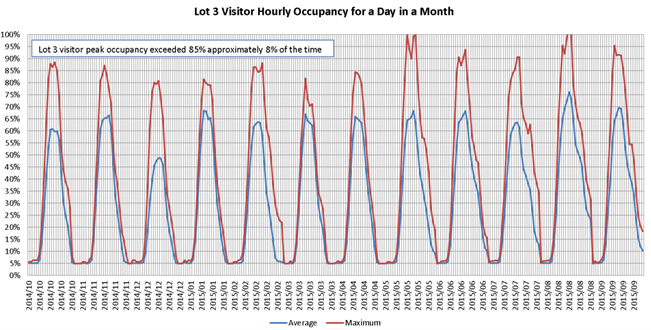
- Obtaining the file(s) from the vendor’s data management program in .csv (Excel) format or text format;
- “Cleaning” the data by discarding bad records (i.e. parking equipment failures);
- Importing the data into Excel, Microsoft (MS) Access or MS SQL; and
- Using MS Power BI to create dashboards.
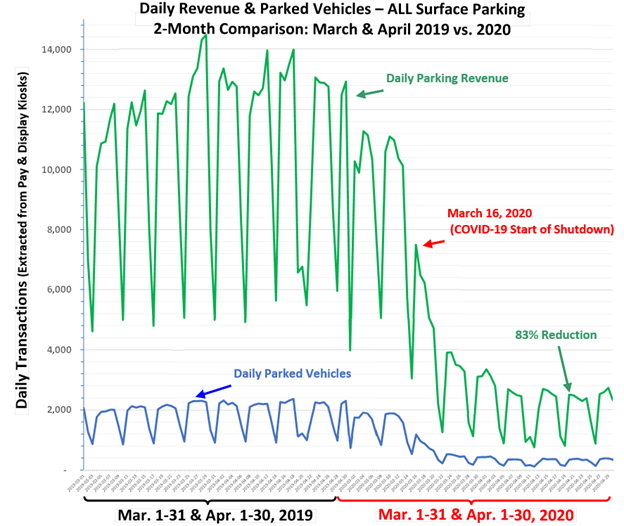
During this period of uncertainty of moving towards the post-COVID-19 world, closely measuring and monitoring parking occupancy and revenue performance provides invaluable, readily available facts upon which to make parking policy decisions over a short timeframe about:
- Changing the mix and quantity of parking: employee, public, reserved, unreserved, carpooling, EV (Electric Vehicle) and accessible spaces;
- Adjusting parking fees;
- Changing time limits;
- Benchmarking among parking facilities and comparisons within the municipality and to other municipalities;
- Making policy changes to minimum and maximum parking requirements specified in municipal zoning bylaws and linking parking occupancy to such requirements and co-related to Gross Floor Area (GFA);
- Reviewing parking cash-in-lieu policies;
- Leasing underutilized parking spaces to neighbouring properties, such as businesses and community services;
- Re-purposing parking spaces for other uses such as storage, bicycle parking, micro-hub delivery points, redevelopment or sale of surplus land;
- Continuing social distancing by reconfiguring parking facilities if space and geometrics allow; and
- Curbing management policies to allow for efficient pickup zones to support “main street” businesses (already implemented in several municipalities during COVID-19) and reduce challenges and conflicts posed by multiple “curb” users: transit riders, cyclists, pedestrians and ride-hailing services (i.e. Uber, Lyft and others).
The views expressed in this blog post are those of the author(s), and may not reflect the position of the Ontario Professional Planners Institute.
Post by Vince Mauceri, RPP