July 21, 2020
Parking Lot Design with Winter in Mind: LSRCA’s Parking Lot Design Guidelines to Promote Salt Reduction
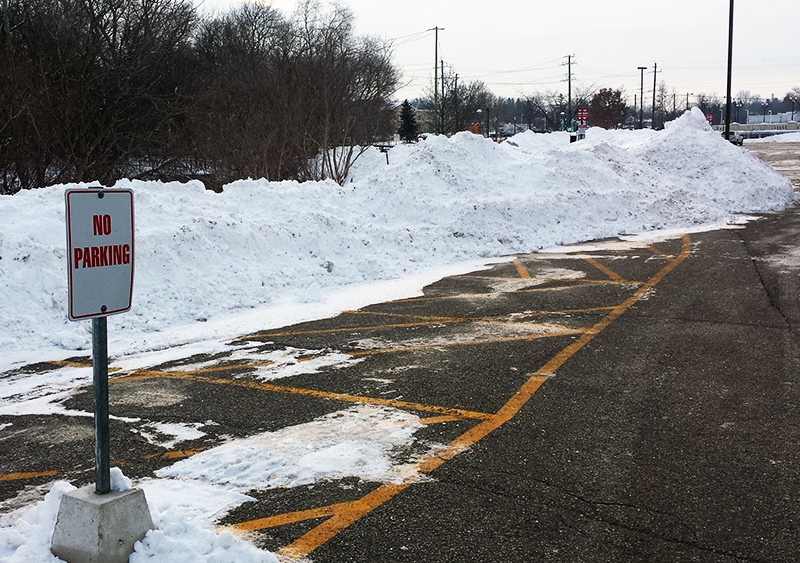
A properly signed and placed snow pile.
As discussed in my June post, the use of salt in parking lots can cause major issues for the parking lot and the building infrastructure surrounding it, and ultimately the freshwater resources receiving the melt water. As this issue becomes more predominant, there has been a push to reduce salt use from many sources. In 2017, LSRCA worked with GHD to develop Parking Lot Guidelines to Promote Salt Reduction to help tackle this issue.We developed these guidelines to demonstrate to those involved in the planning, design, and maintenance of parking lots that they can be designed to require less salt to maintain an acceptable level of service and safety. Through stakeholder interviews and design charrettes, we identified four design features that can help to reduce the amount of salt needed to maintain safe conditions. We also developed two companion documents to accompany the guidelines:
- a Fact Sheet that provides high level information;
- and template municipal policies to help municipal planners incorporate the guidelines into various municipal planning documents, from Official Plans to Site Plan Agreements. These template policies were developed collaboratively with planning and water resources staff from municipalities around the Lake Simcoe watershed to ensure they could be easily adapted and incorporated.
Effective Grading and Stormwater Collection: proper grading of parking lots can minimize freezing of wet pavement surfaces and reduce refreezing of
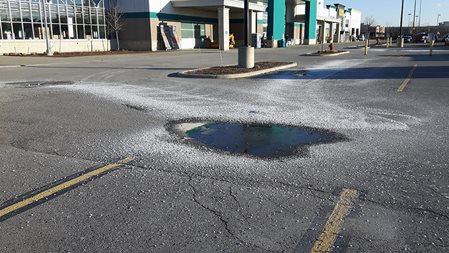 Meltwater pooling in a parking lot, necessitating heavy salt application
- Slopes of 2-4% to minimize the potential for depressions forming.
- Directing melt water towards strategically placed stormwater collection infrastructure (e.g. catch basins, vegetated swales, landscaped areas, etc.), and ensuring that meltwater from high traffic areas drains to a nearby collection point.
- Situate where the pile can receive abundant sunlight.
- Prevent visual obstructions to drivers and pedestrians.
- Clearly mark with signage to inform contractors where to place snow.
- Ensure that melt water drains away from high traffic areas, preferably over a short distance, to a drainage feature.
- Minimize long plow routes.
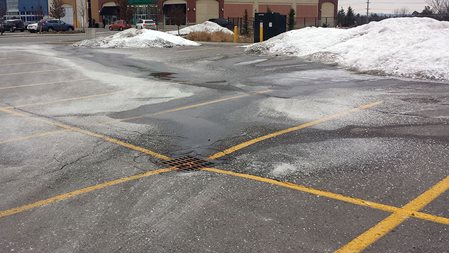 A snow pile placed in close proximity to a drainage feature
- Minimizing the number of walkways and focusing on those that lead from adjacent subdivisions and transit stops.
- Appropriate widths (e.g. >1.5 m wide) to allow contractors to plow rather than using salt to melt snow on sidewalks.
- Using alternative paving materials with more grip.
- Seasonal closures of unused walkways.
- Heated walkways, where appropriate (e.g. near store entrances).
- Strategic use of trees, either to provide windbreaks in the case of evergreens, and shade or sun at appropriate times of year in the case of deciduous trees.
- Ensuring that the vegetation used in areas receiving runoff are salt tolerant.
The views expressed in this blog post are those of the author(s), and may not reflect the position of the Ontario Professional Planners Institute.
Post by Pamela Strong